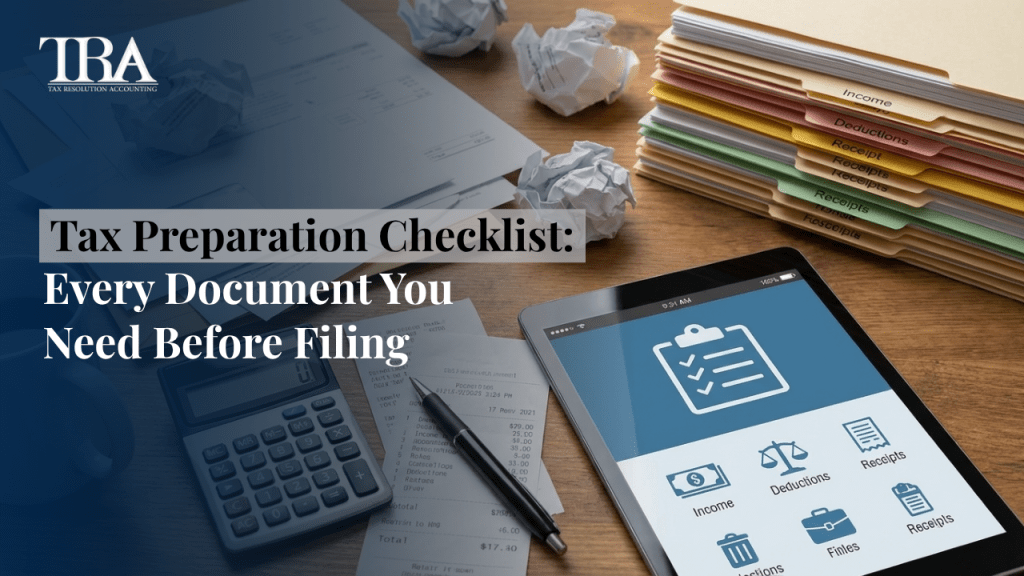
Tax season has a way of sneaking up on people.
One day you’re thinking, 2018I2019ll get to that next week,2019 and then suddenly it’s mid-April, a deadline is looming, and you’re digging through a pile of paperwork wondering where your W-2 went.,
Sound familiar? You’re not alone.
The truth is, most of the stress that comes with tax season isn’t really about the taxes themselves. It’s about being unprepared. Missing a document, forgetting a deduction, or scrambling to pull records together at the last minute, these are the things that turn a manageable process into a frustrating one.
That’s why having a clear tax preparation checklist matters so much.
At Tax Resolution Accounting, we work with individuals and businesses across Virginia to make tax filing as smooth as possible. Whether you’re filing a personal return or managing a business, knowing exactly what documents you need before you sit down with your tax preparer makes all the difference.
In this guide, we’ll walk you through every document you should have ready before filing, so you can walk into tax season with confidence instead of chaos.
Start Here: Why a Checklist Changes Everything
A lot of people treat tax preparation like a once-a-year scramble. And for a long time, that might work fine. But as your life or business gets more complex, more income sources, more deductions, more moving parts, flying blind gets expensive.
When you show up to file with everything in order, you give your tax preparer what they need to do their best work. That means fewer delays, fewer back-and-forth requests for missing records, and a much higher chance of catching every deduction you’re actually entitled to.
So let’s get into it.
Personal Information You’ll Always Need
Regardless of whether you’re filing as an individual or a business owner, every return starts with the basics. Make sure you have:
- Your Social Security Number (SSN) or Individual Taxpayer Identification Number (ITIN)
- Social Security Numbers for your spouse and any dependents
- Date of birth for yourself, spouse, and dependents
- Last year’s tax return (this is especially helpful for your preparer)
- Bank account information for direct deposit of any refund
- Your current mailing address
These might seem obvious, but you’d be surprised how often small errors in personal information slow down a return or cause an IRS notice.
Income Documents: Every Source Counts
The IRS knows what you’ve earned. Your job is to make sure your return matches. Gather income documents from every source, even if it seems small.
For Employees
- W-2 from each employer (you should receive these by the end of January)
- Any additional W-2s if you changed jobs during the year
For Self-Employed Individuals and Freelancers
- 1099-NEC forms from any client who paid you $600 or more
- 1099-K if you received payments through a platform like PayPal, Venmo, Stripe, or similar services
- Records of all other business income, even if you didn’t receive a 1099
Other Income Sources
- 1099-INT for interest income from bank accounts
- 1099-DIV for dividend income
- 1099-B for proceeds from stock or investment sales
- 1099-R for retirement distributions (pensions, IRAs, 401(k)s)
- SSA-1099 if you received Social Security benefits
- 1099-G for any unemployment compensation received
- K-1 forms if you have income from a partnership, S-corporation, trust, or estate
- Rental income records if you own investment property
- Alimony received (if your divorce was finalized before 2019)
If you’re not sure whether a source of income needs to be reported, the safe answer is yes, and your tax preparer can help you determine how it’s treated.
Deduction and Credit Documents: Don’t Leave Money on the Table

This is where many taxpayers lose out. Deductions and credits reduce what you owe, sometimes significantly. But you can only claim them if you can document them.
Homeownership
- Form 1098 showing mortgage interest paid
- Property tax statements
- Records of any energy-efficient home improvements (these may qualify for a federal tax credit)
- Closing documents if you bought or sold a home during the year
Education
- Form 1098-T from any college or university (tuition payments)
- Receipts for qualifying educational expenses
- Student loan interest statement (Form 1098-E)
Charitable Contributions
- Receipts or acknowledgment letters from qualifying charities
- Documentation for any non-cash donations (clothing, household items, vehicle donations)
- Records of mileage driven for charitable purposes
Healthcare
- Form 1095-A if you received health insurance through the marketplace
- Records of out-of-pocket medical expenses (if you itemize)
- HSA or FSA contribution and distribution statements
Retirement Contributions
- Records of IRA contributions made for the tax year
- Confirmation of any SEP-IRA or SIMPLE IRA contributions if self-employed
Missing even one of these documents can mean leaving money behind. A professional tax preparer knows where to look, but they can only work with what you bring them.
Business Owner? Here’s What You’ll Need on Top of the Basics
If you’re self-employed, a sole proprietor, or running a business of any kind, your tax preparation checklist is longer, but it also comes with more opportunity to reduce what you owe.
Gather these documents before your appointment:
- Profit and loss statements for the year
- Business bank account statements
- Records of all business income (invoices, payment records, 1099s received)
- Receipts for all deductible business expenses: office supplies, equipment, software, advertising, professional services, travel, meals, and more
- Mileage logs for business vehicle use
- Home office records if you work from home (square footage, utility bills)
- Payroll records and W-2s issued to employees
- 1099-NEC forms you issued to contractors
- Records of estimated tax payments made throughout the year
- Business insurance premium payments
- Loan or lease agreements for equipment or vehicles
- Prior year business tax return
The more organized your business records are, the more your tax preparer can do with them. If your bookkeeping has been inconsistent during the year, this is also a good time to think about getting that cleaned up before next tax season.
Explore our bookkeeping services at Tax Resolution Accounting.
Don’t Forget These Commonly Overlooked Documents
Even experienced filers miss things. Here are some documents that often get forgotten, and cost people money as a result:
- Estimated tax payment records: If you made quarterly payments to the IRS (or to Virginia), bring the amounts and dates. These are a direct credit against what you owe.
- Prior year state tax refund: If you received a state tax refund last year and itemized deductions, that refund may need to be reported as income.
- Childcare provider information: If you paid for daycare, after-school care, or a summer day camp, you may qualify for the Child and Dependent Care Credit. You’ll need the provider’s name, address, and Tax ID.
- Adoption expenses: If you adopted a child, certain expenses may qualify for the Adoption Tax Credit.
- Energy efficiency upgrades: New windows, doors, insulation, solar panels, and other qualifying home improvements may be eligible for credits.
- Gambling winnings and losses: Winnings are taxable income. Losses may be deductible if you itemize, but you need records for both.
- Cryptocurrency transactions: If you bought, sold, or exchanged any digital assets, you need records of those transactions. The IRS is paying close attention to this area.
- Foreign income or accounts: If you have income from foreign sources or financial accounts held abroad, there are specific reporting requirements your preparer needs to know about.
A good tax preparer will ask about many of these. But the more you come in knowing, the smoother the conversation goes.
What Happens If You’re Missing Documents?

Life gets busy. Records get lost. It happens.
If you’re missing a W-2 or 1099, your first step is to reach out to the employer or institution that should have sent it. Most forms are required to be mailed by the end of January, and many are now available digitally through payroll portals or financial institution websites.
You can also request copies of prior year returns and income transcripts directly from the IRS. This can help you piece together income records if needed.
If you truly can’t locate certain records before the filing deadline, filing for an extension may be the right move. An extension gives you more time to file, but it does not extend the time to pay any taxes owed, so it’s important to estimate carefully.
This is where working with a professional tax preparer makes a real difference. We can help you figure out what’s actually missing, what can be reconstructed, and what the right next step is, without making the situation worse by filing incorrectly.
Red Flags That Could Slow Down or Complicate Your Filing
Here are some signs that your tax return may need extra attention this year:
- You changed jobs, moved to a new state, or had major life changes (marriage, divorce, new baby)
- You started a business, went freelance, or had a significant increase in income
- You sold a home, rental property, or investments
- You received an IRS notice or had tax issues in prior years
- You have income from multiple states
- You took an early withdrawal from a retirement account
- Your bookkeeping for the year hasn’t been kept up to date
None of these situations are impossible to handle, but they do require more time, care, and expertise. The earlier you get organized, the better.
How Tax Resolution Accounting Helps Businesses and Individuals Across Virginia
At Tax Resolution Accounting, tax preparation isn’t just a service we offer in April. It’s something we help clients prepare for year-round.
Based in Lynchburg and serving clients throughout Virginia, our team works with individuals, self-employed professionals, and business owners who want more than just a completed return. They want accurate filing, maximum deductions, and the peace of mind that comes from knowing everything was done right.
We combine bookkeeping, tax preparation, and tax resolution services under one roof, which means your records, your filing, and any IRS issues are all handled by a team that knows your full financial picture.
When you come in with a complete checklist, we can focus on finding opportunities to reduce your tax liability rather than chasing down missing documents.
That’s a better experience for everyone.
Frequently Asked Questions About Tax Preparation Documents
What documents do I need to file my taxes?
At a minimum, you’ll need personal identification information, income documents like W-2s or 1099s, and records of any deductions you plan to claim. The full list depends on your tax situation, but this guide covers the most common categories for individuals and business owners.
When should I start gathering documents for tax season?
As early as possible. Most income documents are issued by the end of January, so February is a good time to start pulling everything together. The earlier you start, the more time you have to find anything that’s missing.
What if I’m missing a W-2 or 1099?
Contact the employer or institution that should have sent it. If you can’t track it down, your tax preparer can help you access income transcripts from the IRS to fill in the gaps.
Do I need records for small business expenses?
Yes. Every deductible business expense should be documented with receipts, invoices, or bank statements. Organized expense records not only support your deductions but also protect you in the event of an audit.
Can a tax preparer help me figure out what documents I need?
Absolutely. A good tax preparer will review your situation and let you know if anything is missing before your return is filed. At Tax Resolution Accounting, we walk every client through what we need so nothing gets overlooked.
How long should I keep my tax documents?
Generally, the IRS recommends keeping tax returns and supporting records for at least three years. If you filed a claim for a loss from bad debt or worthless securities, keep those records for seven years. Business records may need to be kept longer depending on your situation.
Is it worth using a professional for tax preparation?
For most people, yes, especially as income, life circumstances, or business complexity increases. A professional tax preparer can identify deductions and credits you might miss, reduce the risk of errors, and save you significant time and stress.